
Security cameras for Guanacaste hotels that are still recording a year from now.
Maple Connection installs, documents, and then watches the camera system at boutique hotels, lodges, and vacation rentals across Guanacaste, roughly within two hours of Liberia. Weather-rated cameras, a protected recorder, and a second copy kept off-site.
Three ways cameras quietly stop recording on this coast.
A camera that has been dark for weeks does not tell you. You find out the day you need the footage.
Salt air and humidity
Salt air eats cheap hardware and humidity kills storage drives. Cameras and recorders have to be built for the coast, not for a climate-controlled office.
Power cuts
A power cut can corrupt a recording on an unprotected recorder without any alert. The recorder has to be protected, and the core equipment has to ride through the cut.
Nobody checks
Most properties learn a camera stopped when they go looking for footage. Verifying that every camera is still recording has to be somebody's job. Here it is ours.
One camera system, five jobs.
A managed system is more than cameras on a wall. It is what keeps them recording and keeps the footage findable.
-
01
One place for every camera
Every camera at the property sits on one system. If you operate more than one property, they run from one console, with the same camera view for all of them.
-
02
Remote verification
Cameras are verified remotely, so a camera that went down is found without anyone driving out to the property to look.
-
03
Footage you can find
Playback has plain-language search, so "back gate, Tuesday 2pm" is one search away instead of an evening of scrubbing through recordings.
-
04
A second copy off-site
The second copy goes off-site automatically, with no monthly cloud fee, so the footage does not live only on the recorder at the property.
-
05
Alerts reach us first
Monitoring catches a camera that stopped recording, and the alert comes to us first. The fix is already moving before it matters. When hands are needed, a local Guanacaste crew goes on site.
Cameras are only as good as the power and the line behind them.
A recorder without power and a network without internet see nothing.
The core equipment gets battery backup, so a power cut does not take the link down with it. Two internet providers where the location supports it, with automatic failover when the primary line gets cut. We plan Starlink as the backup link where fiber or Liberty reaches the property, and as the primary where fiber does not reach.
One of six systems, run as one job.
Cameras sit on the same network as everything else, and one team answers for all of it.
Surveillance is one of the six systems we install and manage, with network and voice, Wi-Fi, access, site connectivity, and automation and sensors. Cameras are wired over a single cable for power and data, and they sit on their own network, so a guest streaming on the lounger never reaches them. One team owns it when any of it needs attention.
The equipment is yours. So is the paperwork.
Month to month, no long contracts. If you stop, you keep what was built.
The hardware is yours
Equipment is procured at documented cost, or bought by you from the site plan. Either way it belongs to the property and stays with it.
The documentation is yours
Every camera, credential, IP, and cable run is written down and handed back to you on request. No more "the guy who set this up is gone."
No lock-in
Month-to-month. No long contracts, no lock-ins, no surprise invoices. You keep the documented environment either way.
How support works after the install.
Remote first, on site when it matters.
We monitor the system remotely and fix most of what breaks remotely. When hands are needed, a local Guanacaste crew goes on site. A monthly report shows what was watched, and one team owns every problem. To be plain about the line: camera-footage review, active security monitoring, and alarm dispatch are not part of management.
Two properties running on it.
A rental villa in Playas del Coco and a residential estate in Huacas. Each case study shows what was there before and what runs now.
Playa del Coco Villa
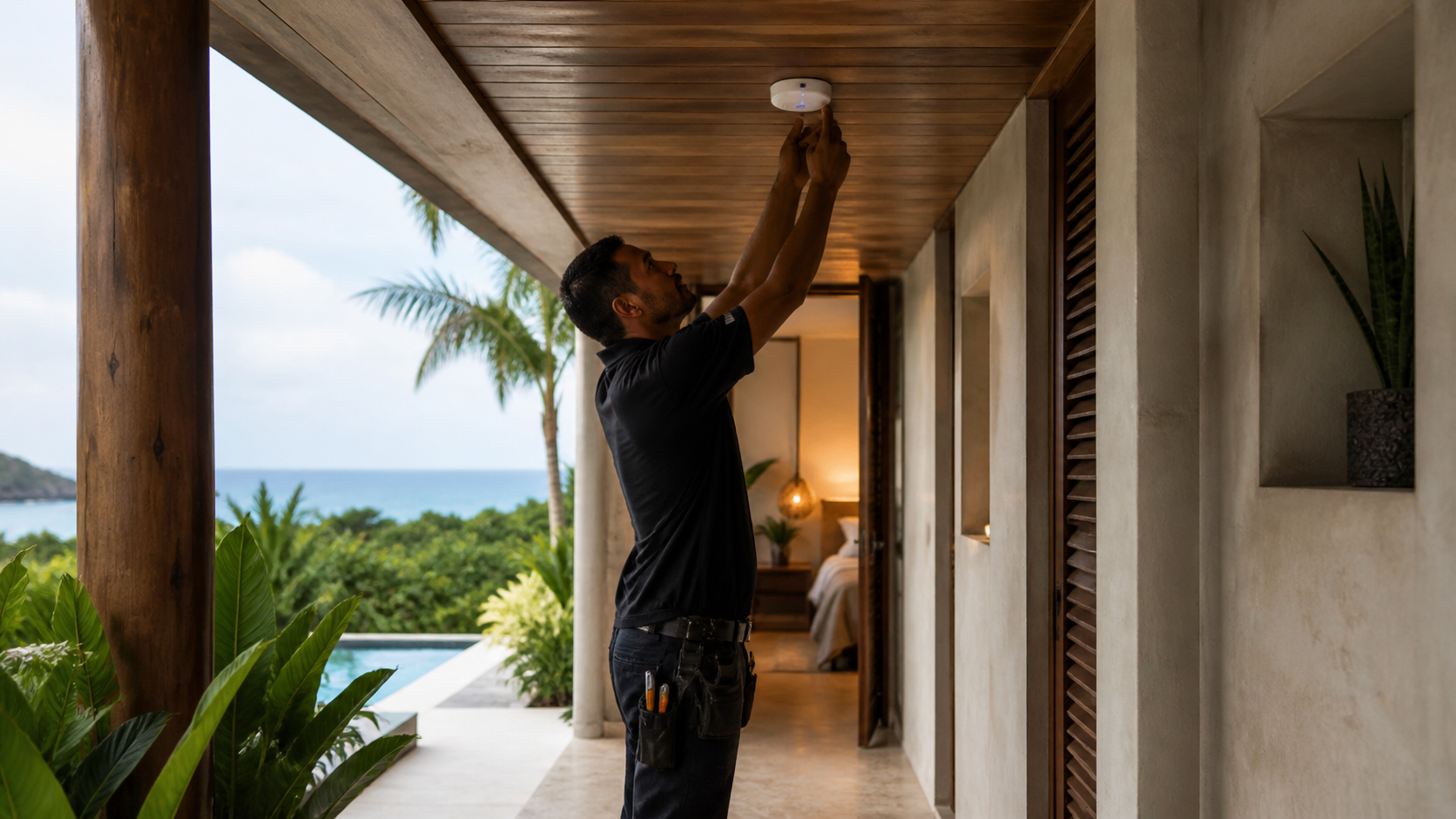
Playas del CocoGuest Wi-Fi and cameras rebuilt to the standard the Canadian practice runs. First Costa Rica deployment.
Huacas Residence
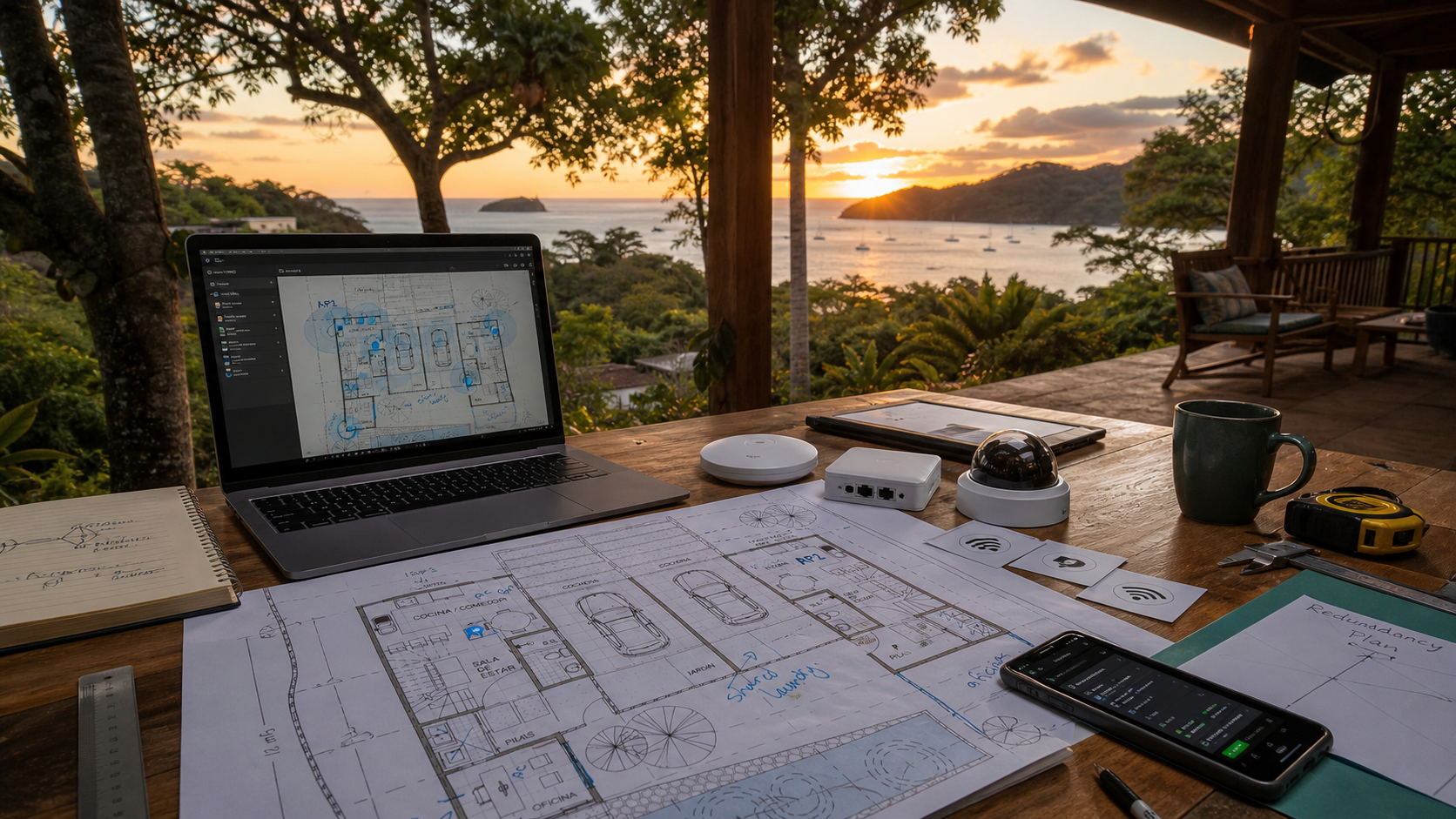
HuacasFull-property network, surveillance, and managed connectivity for a multi-building residential estate.
What owners ask first.
What happens after I get in touch?
You answer a few questions about the property. We reply within one business day. The work itself starts with a walk of the site, and the monthly figure comes with the plan.
Does someone watch the cameras live?
No. We keep the system running: we verify the cameras are still recording, keep the second copy off-site, and fix what breaks. Camera-footage review, active security monitoring, and alarm dispatch are not part of management.
We already have cameras. Do you start over?
The first step is to walk the property and map what is there: network, Wi-Fi, cameras, POS, access, sensors. We identify what is fragile and what is going to fail next, and plan from that.
Where do you work?
Permanent operations in Guanacaste. Reach extends into the Arenal foothills, northern Puntarenas, and the southern Nicoya peninsula as far as Sámara and Nosara, roughly within two hours of Liberia. That covers Tamarindo, Nosara, Sámara, and Playas del Coco.
What it costs.
Prices start from the plans below; the exact monthly figure comes with the plan after the site walk.
Tell us which cameras you cannot trust.
Answer a few questions about the property. We reply within one business day.
Start IntakeEnglish · Spanish · We reply within one business day.